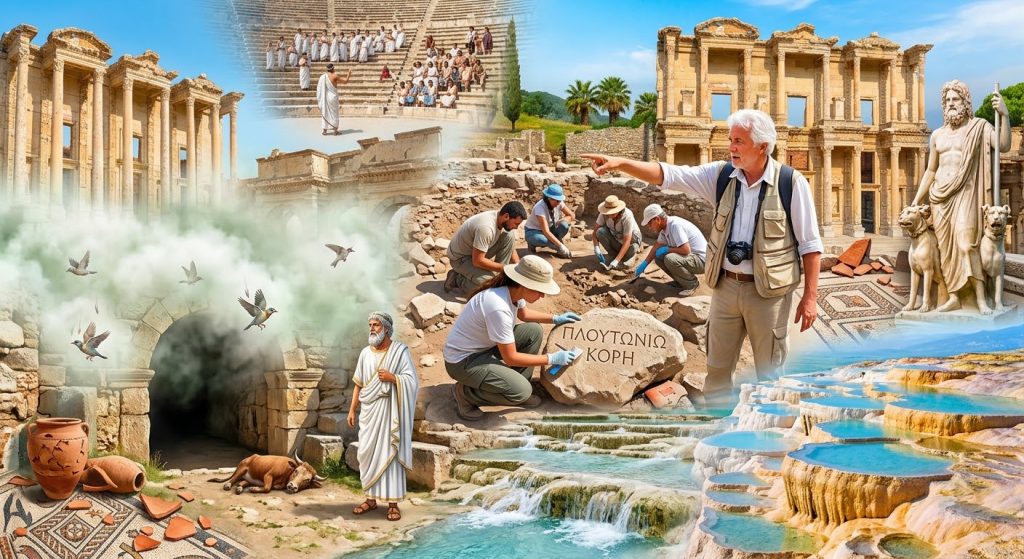
For centuries, myths regarding entryways to the underworld captivated the imagination of historians. Many ancient civilizations maintained traditions describing specific geographic locations where the division between the realm of the living and the domain of the dead was so thin that the underworld’s breath seeped through. Classical writers left detailed accounts of such portals, though modern historians long considered them poetic metaphors. That perception changed when Italian archaeologists in southwestern Turkey unearthed the physical site known in Greco-Roman lore as the Gate to the Underworld, or the Plutonium.
According to historical records, this sanctuary was situated in the ancient Phrygian city of Hierapolis. Today, near these majestic ruins lies the renowned Turkish thermal resort of Pamukkale. The excavation team not only identified the gateway itself, but also formulated a scientific explanation for the lethal phenomena that inspired terror across the ancient world.
The mystery of lethal vapors in ancient Hierapolis
Hierapolis was founded by King Eumenes II of Pergamon in 190 BC. Later absorbed into the Roman Empire, it grew into a prosperous metropolis with grand theaters, temples, and thermal springs that attracted thousands of travelers. Yet the city’s greatest fame stemmed from the Plutonium: an opening to a subterranean cavern enveloped in thick white vapor.
The Greek geographer and historian Strabo, who visited the site at the turn of the common era, described it with awe and trepidation. He noted that the area surrounding the cave opening was so filled with dense, suffocating mist that the ground was obscured. Any living creature that ventured into the space met immediate death. Birds flying across the opening suffocated mid-flight and plummeted lifeless. Ancient observers viewed this as irrefutable proof that here lay a direct portal to the god of the underworld.
How Francesco D’Andria’s expedition solved the enigma
The precise location of the Plutonium had been lost following earthquakes that devastated the city. Italian archaeologists led by Professor Francesco D’Andria adopted a novel methodology. Rather than searching for standard temple foundations, they mapped the geothermal fault lines and thermal water routes of Pamukkale. This approach led them to a partially collapsed cave entrance buried beneath heavy stone rubble.
Clearing the debris, the team revealed the remains of an impressive sanctuary. They uncovered Ionic semi-columns, stone basins, and tiered seating arranged like an amphitheater directly above the cavern opening. Crucial verification came from carved stone dedications to underworld deities: Pluto and his consort Kore (Persephone).
Mystical rituals and the secret of ancient priests
The discovered architecture corroborated written accounts by classical historians. Worshippers who visited the sanctuary never stepped directly near the threshold. They sat on elevated stone terraces, observing rites from a safe distance to avoid breathing the toxic air. Only initiated priests dared stand before the cave opening.
The ritual was striking: priests led a healthy bull toward the opening, and within minutes hauled out its lifeless carcass, sacrificed to Pluto. Yet the priests themselves remained unaffected. The inner precinct was accessible solely to the eunuch priests of Cybele (the Galli). Strabo hypothesized that they possessed unusual physiology or practiced secret breath-holding techniques.
Modern geology provides a fully rational explanation. The fissure continues to emit lethal concentrations of carbon dioxide arising from deep tectonic faults. Being heavier than atmospheric air, carbon dioxide pools near ground level, creating an invisible, deadly gas reservoir. Animals whose heads remained within this lower layer quickly inhaled fatal doses. The priests, standing fully upright, breathed cleaner air above the gas blanket and knew what time of day thermal winds dispersed the gas most effectively. Additionally, subsoil vapors contained trace hydrocarbons with hallucinogenic properties, accounting for prophetic dreams reported by pilgrims sleeping near the shrine.
The Plutonium remained active until the fourth century AD. In the sixth century, early Christians filled the entrance with soil and masonry to decommission the pagan site, and subsequent earthquakes sealed it completely until modern archaeology unveiled this ancient wonder.