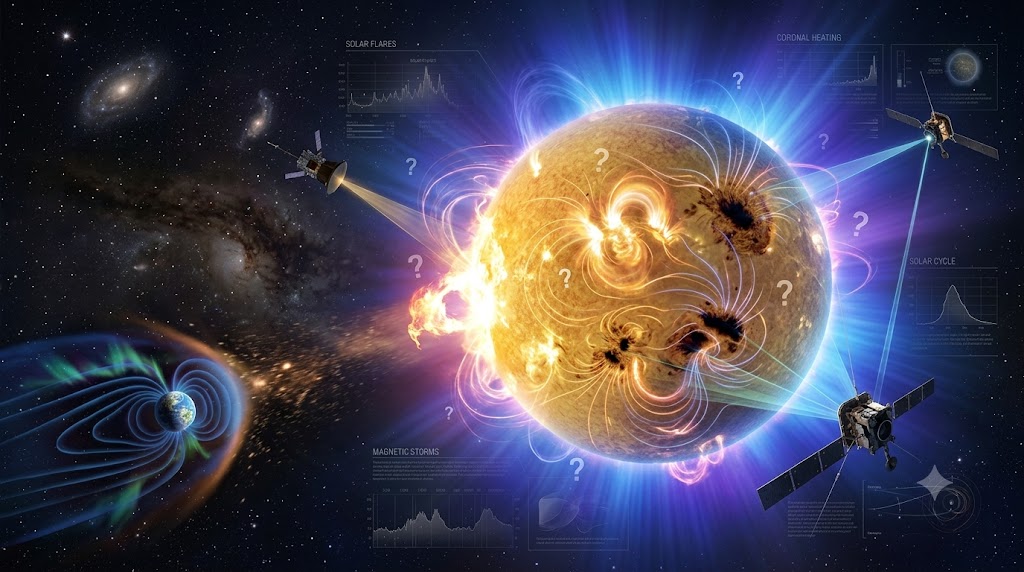
The Sun remains one of the most mysterious objects in our Solar System. Despite humanity studying it for centuries, scientists still do not give up hope of getting as close as possible to unraveling the phenomena occurring in its depths and on its surface. The launch of ultra-modern spacecraft, such as the Parker Solar Probe and Solar Orbiter, has allowed us to literally “touch” the star.
However, new data obtained from super-powerful telescopes often raises even more questions for researchers upon detailed comparison than it provides answers.
Solar Flares and Magnetic Storms: Is There a Threat to Earth?
Powerful explosions—solar flares and coronal mass ejections—regularly occur on the Sun’s surface. At the moment of a flare, the plasma heats up to tens of millions of degrees in a matter of seconds. The released energy, along with giant clouds of charged particles, rushes into outer space, sometimes directly toward Earth. It is these streams of solar wind, colliding with our planet’s magnetic field, that provoke geomagnetic storms.
How Space Weather Affects Humanity
Magnetic storms have a tangible impact on both the well-being of weather-sensitive people and modern technologies. A powerful geomagnetic storm can cause serious disruptions: from radio communication failures and GPS inaccuracies to satellite breakdowns.
It is quite possible that in the event of an extremely strong storm (similar to the Carrington Event of 1859), power grid transformers worldwide could burn out. Although scientists are establishing space weather monitoring services, predicting the exact time and strength of the next strike with a 100% guarantee is still impossible.
The Temperature Paradox: Why is the Corona Hotter Than the Surface?
The Sun has a multi-layered atmosphere in which phenomena occur that seem contradictory from the standpoint of conventional physics. The biggest mystery is the so-called coronal heating problem. The visible surface of the star known to us (the photosphere) has a temperature of about 6,000 °C. However, the outer layer of the solar atmosphere—the corona—heats up to an incredible 1,000,000 °C and higher.
According to the basic laws of thermodynamics, the further an object is from a heat source, the lower its temperature should be. On the Sun, however, the opposite is true. Modern astrophysicists propose several theories as to what exactly heats the atmosphere this way:
- Alfvén waves: Magnetic waves that transfer energy from the depths of the Sun outward.
- Nanoflares: Millions of constant microscopic explosions on the surface, which cumulatively generate colossal heat.
- Magnetic reconnection: Processes involving the sharp rearrangement of magnetic field lines, accompanied by a sudden release of energy.
The Cyclical Nature of the Sun: The Clockwork of the Universe
The Sun lives by its own rhythm. Every 11 years, the star’s magnetic poles swap places, marking a solar cycle. During this time, the number of sunspots (dark, cooler areas with a powerful magnetic field) and flares increases from a minimum to a maximum, and then declines again. There are also hypotheses about global cycles lasting 100, 400, and even 1,000 years.
Fluctuations in solar activity directly affect the Earth’s global climate, but the underlying causes of this “clockwork” mechanism have not been fully unraveled by scientists. The Sun gradually lifts the veil on its mysteries, but its boundless power reminds humanity every time: we are just a tiny part of a grandiose system in which outer space dictates the rules.