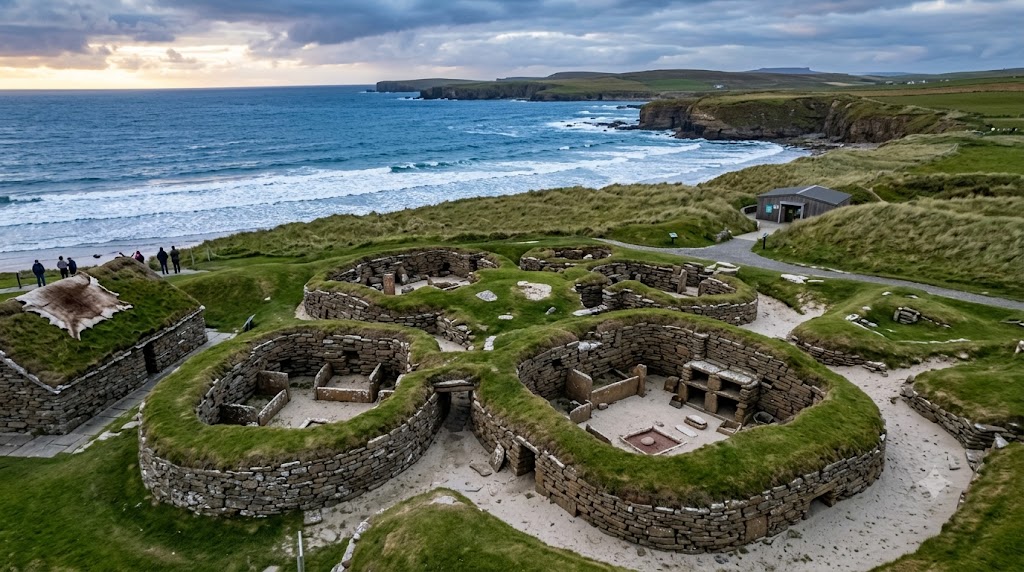
If it weren’t for the severe weather conditions, this unique town on the west of the Orkney Islands might have remained forever hidden under a thick layer of earth. The winter of 1850 proved to be extremely stormy for Britain. In a single night, the fierce elements sank several ships, and a powerful hurricane tore off the top of a sand dune near the Bay of Skaill. When the storm subsided, locals were presented with an amazing view of an ancient settlement that had survived surprisingly well under the sand.
Accidental Discovery and Lost Time
Archaeologists still regret that large-scale excavations began too late – only in 1926 under the leadership of the famous scientist V. Gordon Childe. For seventy-six years after the discovery, locals and aristocratic looters freely stripped Skara Brae for souvenirs, causing irreparable damage to the historical monument. Despite this, the site survived so well that in 1999 it was included in the UNESCO World Heritage list.
Architecture and Everyday Life of the Neolithic Era
Ten stone huts, which in size resembled a modern one-room apartment, were located on a small hill. These are some of the earliest known human dwellings, built in the Neolithic era – around 3100 BC. By comparison, the Egyptian pyramids and the famous Stonehenge are much “younger” structures.
The houses were partially submerged into the ground and lined with organic waste for better thermal insulation in the harsh northern climate. The level of engineering thought of that time is striking: doors were locked with bolts, and a primitive sewage system functioned inside.
The standard layout of a stone house in Skara Brae included:
- A central hearth for heating and cooking;
- Stone beds located on the sides of the room (they were usually covered with soft animal skins);
- Peculiar stone “wardrobes” or shelves for storing pottery and tools.
The settlers lived in this territory for about 600 years. They were actively engaged in farming and foraging – they fished, gathered mussels, grew cereals, and raised cattle. There is also an interesting archaeological find: it is likely that lawbreakers were placed in the “dark room” – a special windowless room that was tightly bolted from the outside.
Why Did the Ancient Civilization Disappear?
This nation remains a complete mystery to modern science. Researchers have never been able to find out what language these people spoke or what ethnic group they belonged to. One day, for an unknown reason, the residents left their homes, not even taking their valuable utensils with them. Some scientists suggest that a sudden sandstorm was the cause, while others lean towards the theory of gradual climate change or social conflicts that forced people to look for new territories to live.
The Italian Chapel and Other Attractions
A trip to Skara Brae is often combined with visiting other interesting places on the Orkney Islands. A typical itinerary includes a visit to the Italian Chapel on the neighboring island of Lamb Holm. It was built in the 1940s by Italian prisoners of war. To construct it, the prisoners used whatever came to hand: cement, wire, leftover paint, and scrap metal. Thanks to the immense patience of its creators, the chapel turned into a true world masterpiece of monumental art.
How to Get to the Tourist Gem
Today, a trip to Skara Brae does not present significant difficulties. The route is well-known, and hundreds of tourists visit the attraction daily. The main thing is to get to Scotland. The most convenient way is to fly to London, and from there to Aberdeen. Next, a ferry trip awaits you to the town of Kirkwall. From Kirkwall, it is about a 20 km drive by car to the archaeological complex itself.