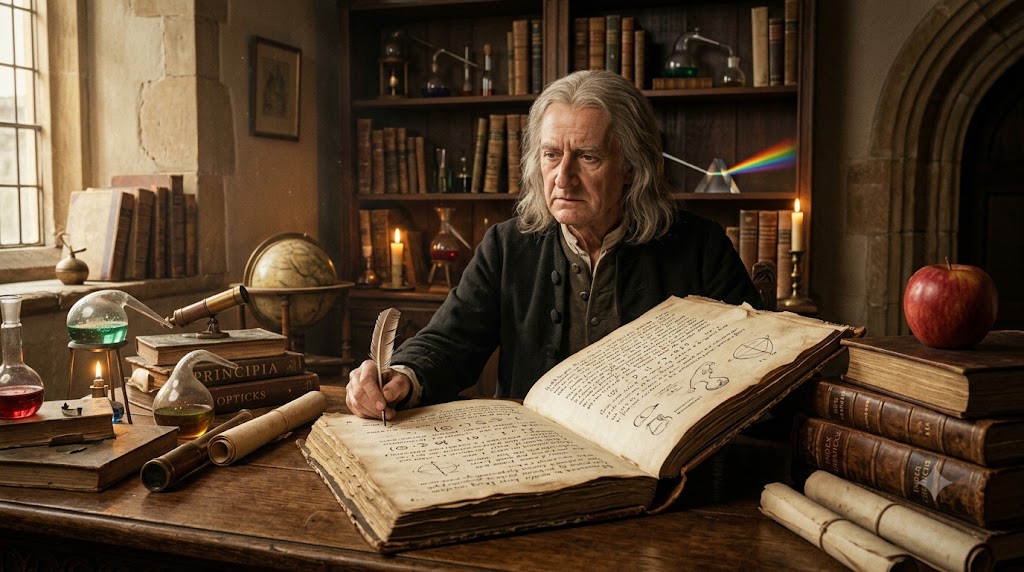
Isaac Newton was not only a brilliant physicist but also a passionate researcher of alchemy, leaving behind encrypted manuscripts that remain unsolved by modern scientists to this day.
Childhood and Growing Up of the Future Genius
Isaac Newton was born on January 4, 1643, in the small English village of Woolsthorpe. He was a very weak baby, and few believed he would survive. His father died before Isaac was born, and his mother left the boy to be raised by his grandmother when he was only three years old. Little Isaac did not like working on the farm, but he loved to read, craft, and explore the world around him. Thanks to his uncle, he returned to school and then entered Cambridge University, where he began making his first scientific discoveries.
Discoveries That Changed the World
At Cambridge, Newton became fascinated with science and made discoveries that made him famous worldwide:
- Three laws of motion: They explain why objects move or stay in place.
- Law of universal gravitation: Legend has it that the idea came to Newton when he saw an apple fall from a tree.
- Study of light: Newton proved that white light consists of all the colors of the rainbow.
- Invention of a new mathematics – calculus: This branch of mathematics helps scientists even today.
Newton was very curious, often worked alone, and could keep his discoveries a secret for years.
Why Did Newton Become Interested in Alchemy?
Besides physics and mathematics, Newton devoted over 30 years to alchemy – an ancient science that sought a way to turn ordinary metals into gold, create the philosopher’s stone, and even bring artificial creatures to life – homunculi. He believed that alchemy would help uncover the deepest secrets of nature.
How Did Newton Work on Alchemy?
The scientist wrote about a million words on alchemy, creating manuscripts such as Index Chemicus (an alchemical dictionary) and Praxis (a description of his own experiments).
He studied the works of famous alchemists: Thomas Aquinas, Roger Bacon, Paracelsus.
To keep his secrets safe, Newton used special symbols (☉ – gold, ☽ – silver, ☿ – mercury) and even signed with the pseudonym “Jeova sanctus unus”.
Alchemists often encrypted their notes so outsiders wouldn’t understand them. Newton also used codes and cryptic words.
The Mysterious Manuscript: A Real Quest for Scientists. Discovery and Decoding Attempts
In 2006, during a routine check at the Royal Society library in London, an unknown manuscript by Newton was found. It consisted of 22 pages, most of which were encrypted. The introduction mentioned alchemists Thomas Aquinas, François Rabelais, and Roger Bacon. The text itself was written in English letters and strange symbols.
Scientists spent three years trying to decode the manuscript using computers but couldn’t read a single page. It turned out that the cipher is extremely complex, and the manuscript itself is a real mystery for modern researchers.
The Amazing History of the Manuscript
In 1936, this manuscript was sold at an auction to an unknown buyer for just 15 pounds sterling. For a long time, it was considered lost until it returned to the library. Today, the manuscript is kept in the archives, waiting for its decoder.
Why Is Newton’s Alchemy Important?
Historian William Newman believes that Newton’s alchemy was a real science of that time, not just magic. He calls it “protochemistry” – the beginning of modern chemistry.
Researcher Sarah Dry writes that Newton himself considered his alchemical and religious studies even more important than physics and mathematics.
Thanks to the “Chymistry of Isaac Newton” project at Indiana University and the digitization of manuscripts in the Cambridge library, thousands of pages of Newton’s alchemical notes have become available to everyone.
Scientists learned that Newton didn’t just dream of gold but experimented with acids, metals, dyes, and even sought the secret to creating homunculi – artificial creatures.
Isaac Newton was not only a genius of science but also a true seeker of secrets. His alchemical research, encrypted manuscripts, and unbreakable codes still inspire researchers and prove: even the greatest discoveries begin with childhood curiosity and a desire to understand the world.