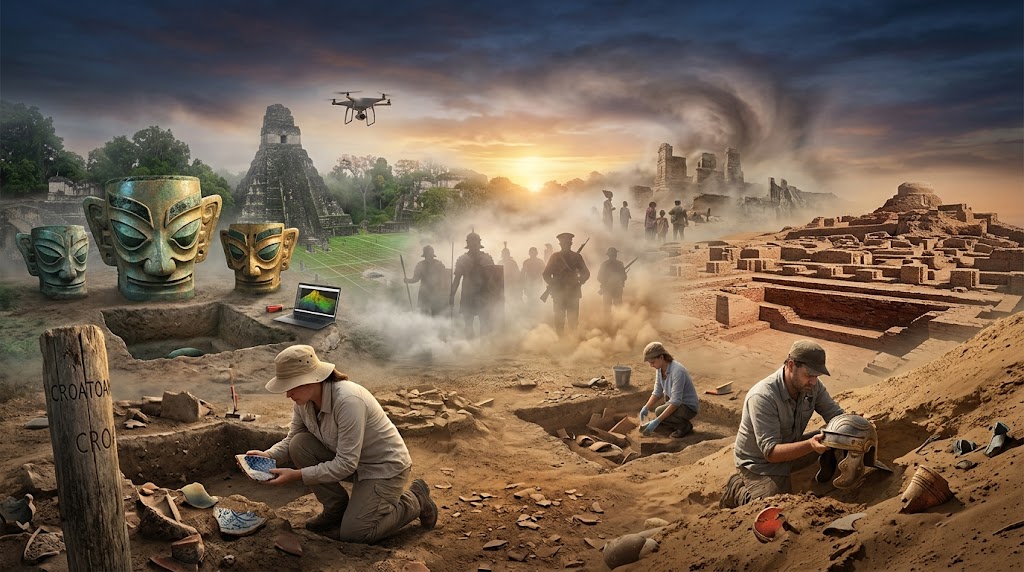
The most mysterious disappearances in history are not just mystical legends, but complex historical events that modern science is gradually unraveling with the help of archaeology, genetics, and the latest technologies. From vanished legions and battalions to entire cities and civilizations – each story combines drama, mysticism, and scientific inquiry.
Marcus Crassus’s Legion: Defeat, Captivity, or Assimilation?
In 53 BC, the Roman commander Marcus Licinius Crassus set out on a campaign against the Parthian Empire, commanding about 35–40 thousand soldiers. Ignoring the advice of allies, his army chose a dangerous route through the Mesopotamian desert. Betrayed by a local guide, Crassus was trapped near the city of Carrhae (modern Harran, Turkey), where the Parthian commander Surena had laid an ambush.
The battle ended in disaster: thousands of Romans died, and another 10,000 were taken prisoner. The fate of these captives has spawned numerous hypotheses. Most historians believe that the legionaries were assimilated in Parthia, guarding the eastern borders of the empire. There is also an exotic “Chinese hypothesis”: some Romans might have reached China, settling in the town of Liqian, where Caucasian features and Roman artifacts have been found among local residents. However, this version remains debatable due to a lack of direct evidence. The legend of the legion’s disappearance in a sandstorm is not confirmed by ancient sources – it is a later myth.
Fact: The disappearance of Crassus’s legion is not mysticism, but the result of a military defeat, betrayal, and harsh environmental conditions. The myths about the “disappearance” arose after the events.
The Norfolk Battalion: A Cloud, a Myth, and the Reality of World War I
On August 12, 1915, during the Gallipoli Campaign, the 1/5th Battalion of the Norfolk Regiment (266 men) received orders to attack Turkish positions. The unit became separated from the main forces, came under heavy fire, and vanished from the sight of their allies. Half a century later, a legend emerged: allegedly, New Zealand sappers saw the battalion walk into a strange cloud, which then lifted and disappeared along with the soldiers.
However, modern research proves that there was no mention of a “cloud” in the accounts from 1915. In 1919, British search teams found the remains of 180 bodies, 122 of which were identified as soldiers of the Norfolk Battalion. Historians concluded that the unit was isolated, ambushed, and almost entirely wiped out. The myth of “disappearing in a cloud” originated much later and has no real basis.
The Mysterious Disappearance of Cities: The Roanoke Colony
In 1587, the English, led by John White, founded a settlement on Roanoke Island (modern-day North Carolina). Among the 118 colonists was Virginia Dare – the first English child born in America. Three years later, after a delay caused by the war with Spain, White returned to find the settlement completely abandoned: houses dismantled, belongings left in place, and no signs of a struggle or bodies. The only clues were the inscriptions “CROATOAN” on a palisade and “CRO” on a tree.
Archaeology and Modern Research
Since 2009, on Hatteras Island (Croatoan), archaeologists led by Mark Horton have been finding 16th-century European artifacts: iron scales, English pottery, a gold ring, and a slate tablet. This indicates the presence of Europeans among the local tribe after the colony disappeared. In 2012, the First Colony Foundation discovered a hidden fort on White’s map, which could point to the colonists’ plans to move inland, but archaeological evidence of a mass relocation has not yet been found.
Additionally, a DNA project was launched in 2007 among the Lumbee tribe, who consider themselves descendants of the colonists. The results remain inconclusive, but integration with local tribes is the most likely version. Dendrochronology showed that during the years the colony disappeared, the region experienced its most severe drought in 800 years, which could have forced the colonists to seek help from their neighbors.
Scientific consensus: Most historians and archaeologists believe that the Roanoke colonists gradually integrated into the Croatoan tribe, rather than dying suddenly or falling victim to violence.
The Disappearance of Entire Civilizations: The Maya, Mohenjo-Daro, Sanxingdui
The Classic Maya civilization (800–900 CE) did not disappear suddenly, but as a result of a complex interaction of environmental and social factors. Modern LiDAR surveys in Guatemala have revealed over 60,000 unknown structures, roads, reservoirs, and fortifications – evidence of high organization and population density. Isotope analysis of stalactites showed that between 800 and 1000 CE, the region experienced a series of droughts, with rainfall dropping to 50–70% of the norm, which became critical for the agrarian economy.
Archaeologists have found traces of massive wars between city-states, fortified cities, and destruction. The decline happened in waves: first local crises, then the mass abandonment of cities. Part of the population remained in rural areas, while new political centers emerged in the northern Yucatán.
Mohenjo-Daro and the Indus Valley Civilization: Climate, Rivers, and Adaptation
The Indus Valley Civilization (c. 1900 BC) declined gradually. Modern science rejects the “Aryan invasion theory” – there is no archaeological evidence of mass destruction. The main cause was climate change: prolonged drought, a weakening monsoon, and shifts in river courses (the Ghaggar-Hakra, identified with the mythical Sarasvati). This led to a reduction in water resources, agricultural degradation, and the migration of the population to the east and south. Skeletal analysis indicates an increase in violence and infectious diseases during the final period, but the decline was gradual and accompanied by adaptation.
Sanxingdui: Bronze Masks, Rituals, and Natural Disasters
Sanxingdui (Sichuan, China, 1200–1000 BC) is one of the most mysterious civilizations of Ancient China. Excavations from 2021–2024 yielded over 13,000 artifacts: huge bronze masks with exaggerated features, gold masks, jade, silk, and ivory. The masks have no equivalents in Chinese art of that time and still spark debates about their purpose.
The reasons for Sanxingdui’s disappearance include a natural disaster (likely an earthquake or a change in the course of the Minjiang River), political transformation (absorption by the state of Shu), as well as the intentional creation of ritual pits during a crisis or religious reform. Modern consensus: the disappearance is the result of a combination of natural disasters, social changes, and political processes.
Mysterious disappearances are always the result of a complex interplay of environmental, social, and political factors. Modern science allows us to discard simple explanations like “sudden catastrophe” or “mystical intervention” and shows that decline occurred gradually, often accompanied by adaptation, migrations, and societal transformation. Nevertheless, the atmosphere of mystery remains, as there are no final answers yet.